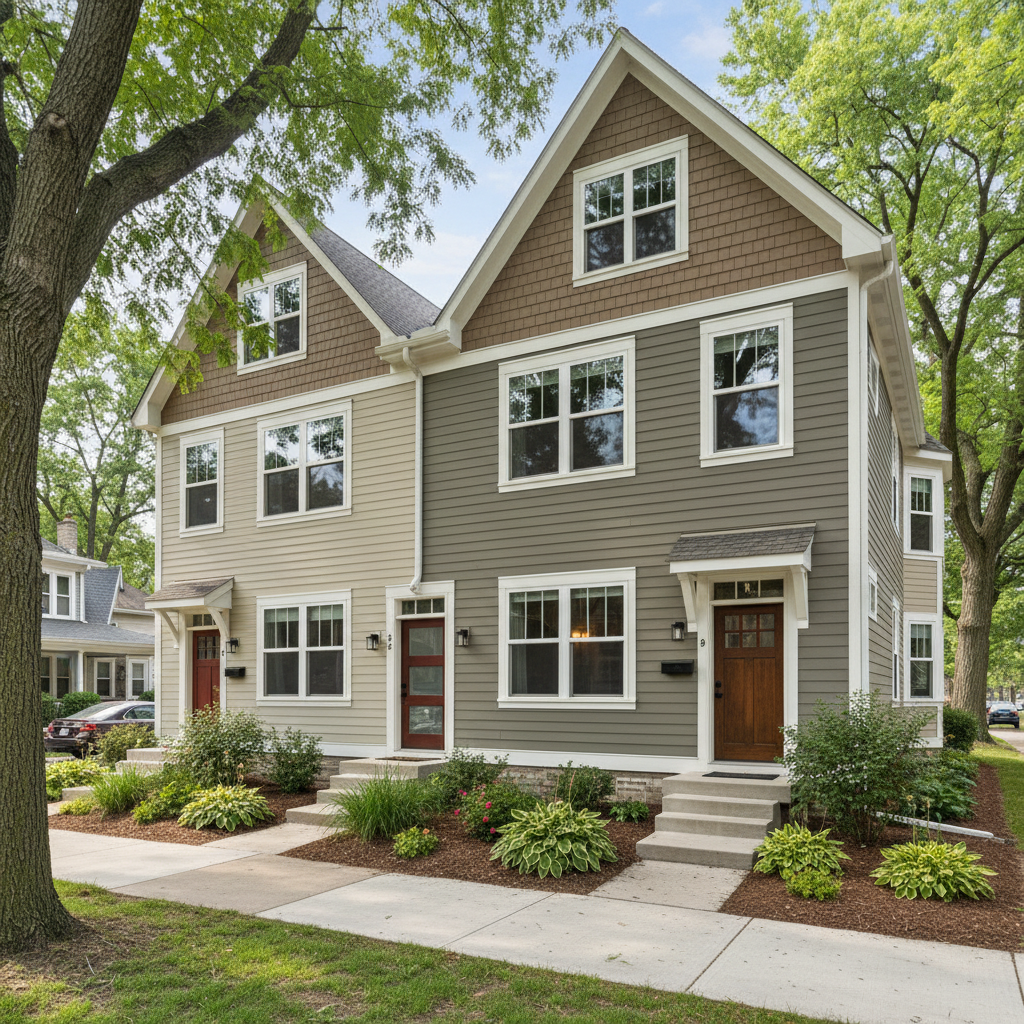
Buying cash flow real estate in the US requires identifying high-demand markets and carefully calculating net operating income to ensure rental yields exceed all ownership costs. Successful investors focus on securing specialized financing, understanding local tax laws, and selecting property types that align with their specific risk tolerance and long-term financial goals.
Most investors chase appreciation, watching property values climb while their bank accounts stay flat and their tenants pay down someone else's mortgage. If that cycle sounds familiar, you are not alone, and you are not wrong to want more. Cash flow real estate flips that equation entirely, putting monthly income in your pocket from day one rather than making you wait years for a payday that is never guaranteed. In this guide, KLR Investments breaks down exactly how to identify, analyze, and acquire income-producing properties in the U.S. market. You will learn which numbers actually matter, how to choose the right city, what the buying process looks like from start to finish, and why markets like Milwaukee are quietly outperforming the rest of the country for serious cash flow investors in 2025.
What Is Cash Flow Real Estate and Why It Matters
Most conversations about cash flow real estate stop at a surface-level formula: collect rent, subtract expenses, keep what remains. That framing misses the operational reality that determines whether a property actually performs.
True cash flow is what survives after every legitimate cost is accounted for: mortgage principal and interest, property taxes, landlord insurance, routine maintenance, a vacancy allowance (typically 8-10% of gross rent), and professional property management fees. The gap between gross rent and net monthly cash flow is often $400 to $700 on a single property. Investors who plan around gross rent numbers routinely discover that their "profitable" property barely breaks even.
For international investors buying cash flow real estate in the U.S., this distinction is not academic. When a property sits 5,000 miles away, it must generate predictable net returns on its own. Speculative appreciation plays require patience, market timing, and a tolerance for years of flat or negative cash flow. Stable monthly income does not.
This is precisely where Midwest markets separate themselves. Coastal cities compress cash flow through high acquisition costs relative to achievable rents. Milwaukee and comparable Midwest markets deliver lower entry prices, stable rental demand, and operating economics that support genuine monthly returns from the start.
The Key Numbers Every Cash Flow Investor Must Know

Understanding what separates a performing asset from a mediocre one comes down to three numbers. Once you can calculate them quickly, buying cash flow real estate in the U.S. becomes a much more disciplined process.
Cash-on-Cash Return (CoC) measures annual pre-tax cash flow divided by the total cash you invested, expressed as a percentage. If you purchase a Milwaukee duplex for $150,000, put $45,000 down (including closing costs), and net $4,500 in cash flow annually after all expenses, your CoC return is 10%. A range of 8-12% is a strong benchmark for buy-and-hold residential property. Below 6%, the risk-adjusted return rarely justifies the illiquidity, particularly for a remote investor.
Cap Rate divides net operating income (NOI) by the property's purchase price. It removes financing from the equation entirely, making it useful for comparing properties across markets or evaluating whether a seller's asking price is justified. Midwest markets routinely produce cap rates of 7-10%, while coastal markets often compress below 4%.
The 1% Rule is a quick screening filter: monthly rent should equal at least 1% of the purchase price. A $150,000 duplex generating $1,600 per month clears that threshold. It does not replace a full cash flow analysis, but it eliminates obvious underperformers before you invest time in deeper due diligence.
As a bonus metric, the Gross Rent Multiplier (GRM) divides purchase price by annual gross rent. Lower GRMs indicate stronger rent-to-price ratios. In Milwaukee, GRMs in the 8-10 range are achievable, compared to 20-plus in many coastal cities.
How to Choose the Right U.S. Market for Cash Flow
Those metrics only produce reliable returns when the market underneath them supports the math. Not every U.S. market is built for cash flow, and choosing the wrong one will undermine even a well-analyzed deal.
In high-cost coastal cities, purchase prices have outpaced rents for years. A property selling for $900,000 in a major coastal market might generate $3,200 per month in rent. That ratio makes positive cash flow nearly impossible regardless of financing structure. The investment thesis there relies almost entirely on appreciation, which introduces timing risk that remote, buy-and-hold investors cannot afford to absorb.
Midwest markets operate on fundamentally different economics. Lower acquisition costs relative to achievable rents create the spread that produces genuine monthly returns. Rental demand in these markets is anchored by structural employment drivers: regional hospitals, state universities, manufacturing operations, and healthcare systems that do not relocate based on economic cycles. That stability matters more to a long-distance investor than a hot market headline.
When evaluating any market for buying cash flow real estate in the U.S., five characteristics define a sound foundation: landlord-friendly state laws that establish clear eviction timelines, historically low vacancy rates, population stability rather than growth speculation, a diversified local economy, and median home prices that keep entry costs manageable.
Milwaukee checks each of these boxes with concrete data behind them. Its median home prices sit well below the national average, rental demand is reinforced by Marquette University, UW-Milwaukee, Froedtert Hospital, and the Milwaukee VA Medical Center, and vacancy rates have remained consistently low. The full case for this market structure is detailed in our analysis of Midwest vs. Coastal real estate investing.
Step-by-Step Process for Buying Cash Flow Property in the U.S.

With a clear understanding of which markets support cash flow and why the numbers work in your favor, the next question becomes practical: how do you actually execute a purchase, particularly from outside the U.S.?
Define your budget and financing structure. Cash purchases close faster and simplify the analysis, but most investors use leverage to improve cash-on-cash returns. Foreign nationals without U.S. credit history can access DSCR (Debt Service Coverage Ratio) loans, which qualify based on the property's rental income relative to its debt obligation, not your personal credit file. A lender reviewing a Milwaukee duplex generating $1,600 per month against a $900 monthly mortgage payment sees a DSCR above 1.0 and a fundable deal. Conventional mortgages are harder to access without U.S. income documentation, making DSCR the standard path for international buyers.
Select your target market and property type. Single-family homes offer simpler management; duplexes and small multifamily properties (2-4 units) produce stronger cash flow per dollar invested. Both work in Milwaukee at current price points.
Build your local team before you make any offers. An investment consultant, a buyer's agent with investor experience, a licensed property manager, and a U.S. CPA who handles foreign investor tax matters are not optional extras for a remote buyer. They are the operating system. Our investment consulting and acquisition services are structured specifically around this coordination role.
Analyze every property using the three core metrics. Run cash-on-cash return, cap rate, and the 1% rule on each candidate. Eliminate underperformers before investing time in deeper review.
Conduct thorough due diligence. A professional inspection, clear title search, and, for multifamily properties, a review of the existing rent roll and lease terms are non-negotiable steps before committing.
Close with the LLC already in place. Most guides treat the legal structure as an afterthought. It should not be. Establishing your U.S. LLC before closing ensures the property transfers directly into the protected entity, eliminating the personal liability window that exists if you close in your own name and transfer later. Immediately after closing, activate your property management agreement so the property operates under professional oversight from day one.
LLC Ownership and U.S. Tax Basics for Foreign Investors

Closing with the right legal structure in place is only the beginning of the compliance picture. For Israeli and international investors, understanding how U.S. law treats foreign-owned property is not optional background knowledge; it shapes how you hold the asset, how you report income, and what happens at the point of sale.
The U.S. LLC as the standard holding structure offers three practical advantages. First, personal liability stops at the entity level; a tenant claim against the property does not reach your personal assets. Second, LLCs are treated as pass-through entities by default, meaning the income flows to the member's tax return rather than being taxed twice at the corporate level. Third, having the property titled in an LLC from day one simplifies property management agreements, banking, and expense tracking.
FIRPTA withholding applies when a foreign investor sells U.S. real property. The buyer is required to withhold 15% of the gross sale price and remit it to the IRS. This is not an additional tax; it is a prepayment mechanism against any capital gains liability owed. The actual tax due may be lower, and the difference is reconcilable through filing.
Rental income and the ECI election matter for annual reporting. When a foreign investor elects to treat rental income as Effectively Connected Income, it becomes subject to U.S. income tax, but that election also unlocks deductions for depreciation, mortgage interest, property management fees, and operating expenses. Without the election, the IRS withholds a flat 30% on gross rents with no deductions allowed.
The U.S.-tax treaty countries provides additional relief, potentially reducing withholding rates on certain income categories. The specific application depends on individual circumstances.
None of the above constitutes legal or tax advice. Every investor's situation involves variables that require a qualified U.S. CPA with direct experience handling foreign national tax matters. This is one reason investment consulting and acquisition services built around Israeli investors include tax-focused financial coordination as a core component, not an add-on.
Remote Ownership: How to Manage a U.S. Rental Property from Abroad

The tax and legal structure answers the compliance question. The operational question that follows is equally direct: can you own and manage U.S. rental property without ever setting foot on the premises? With the right systems in place, yes, and this is exactly how the majority of international investors buying cash flow real estate in the U.S. structure their portfolios.
The foundation is a licensed property manager. For a fee of 8-12% of monthly rent collected, a qualified property management company handles tenant screening, lease execution, maintenance coordination, and rent collection. That fee is also a deductible operating expense, not a cost that quietly erodes your return. What it buys is a local professional whose livelihood depends on keeping your property occupied and maintained.
Alongside that, your U.S. LLC should have its own domestic bank account. Rents flow in, expenses flow out, and your monthly statements reflect actual property performance with no currency conversion ambiguity until you choose to repatriate funds.
Most property managers today operate through owner portals that provide real-time access to rent receipts, maintenance requests, and financial reports. You can review a repair invoice or check occupancy status from Tel Aviv as easily as from Milwaukee.
The coordinating layer above all of this is an investment consultant embedded in the local market. Our investment consulting and acquisition services are built around exactly this role: sourcing vetted properties, coordinating the acquisition team, and providing ongoing portfolio oversight so that remote ownership stays predictable rather than reactive.
Common Mistakes First-Time Cash Flow Investors Make
Predictable systems reduce risk. But even well-structured remote ownership arrangements fail when investors arrive at the acquisition stage carrying assumptions that don't survive contact with actual operating data. These are the five mistakes that surface most often, and each one is avoidable.
Underestimating vacancy and maintenance reserves. Many first-time buyers model their cash flow using optimistic occupancy and zero repair line items. The standard reserve allocation is 10% of gross rent for vacancy and another 10% for maintenance. On a property generating $1,600 per month, that is $320 set aside before a single bill is paid. Ignoring those reserves doesn't improve returns; it just defers the reckoning until a roof repair or a two-month vacancy makes it unavoidable.
Buying in a market you don't understand. Without local expertise, investors routinely overpay for properties in neighborhoods where rents don't support the purchase price, or where tenant demand is structurally weaker than aggregate market data suggests. A strong city-level statistic can mask a problematic block. Local knowledge closes that gap.
Forming the LLC after closing. Transferring a property into an LLC post-closing is not equivalent to closing into it directly. The transfer creates a window of personal exposure and, depending on the lender, can trigger a due-on-sale clause. The entity should exist before the purchase contract is signed.
Treating property management as a commodity. The difference between an 8% and a 14% vacancy rate is almost entirely a management execution question: how quickly units are turned, how rigorously tenants are screened, how proactively maintenance is handled. A lower management fee from an underperforming company consistently costs more than a slightly higher fee from one that keeps units occupied.
Prioritizing appreciation over cash flow. In markets where appreciation is structurally uncertain, an investment thesis built on price growth is speculation with a cash flow problem attached. When buying cash flow real estate in the U.S., the monthly return should justify the investment independently. Appreciation, when it occurs, is a secondary benefit, not the primary underwriting assumption.
Why Milwaukee Is a Top Market for Cash Flow Real Estate in 2025
All five of the mistake categories above share a common solution: buy in a market you can underwrite with real data, supported by people who operate there daily. Milwaukee holds up under that standard in ways that matter specifically for buying cash flow real estate in the U.S.
Median home prices in Milwaukee sit roughly 40-50% below the national average, which means entry costs are manageable and cash-on-cash returns start from a more favorable position before a single tenant signs a lease. A duplex that would require $600,000 in a coastal city trades in Milwaukee neighborhoods for $120,000 to $180,000, and the rent differential between those markets does not come close to matching the price gap.
Rental demand here is not cyclical. Marquette University, UW-Milwaukee, Froedtert Hospital, and the Milwaukee VA Medical Center collectively employ and enroll tens of thousands of residents who rent rather than own. That tenant base is structurally stable across economic conditions.
Wisconsin's landlord-friendly regulatory environment also means eviction timelines are clear and predictable, which protects cash flow in ways that legal environments in many coastal states do not.
The full breakdown of Milwaukee's investment case is covered in our analysis of why Milwaukee ranks among the best U.S. cities for foreign investors. KLR Investments has spent eight years sourcing and vetting properties in this market specifically, which means the local knowledge gap that drives most remote investor mistakes is already closed before you make your first offer.
Successfully building a portfolio of cash flow real estate requires patience, thorough research, and a clear understanding of market dynamics. While the process can be rewarding, managing property selections and financial analysis often becomes complex for individual investors. If you want expert help navigating these opportunities, we invite you to learn more about KLR INVESTMENTS LLC and our approach to property acquisition. Having a dedicated partner can simplify your journey and ensure your investment strategy aligns with your long-term financial goals.